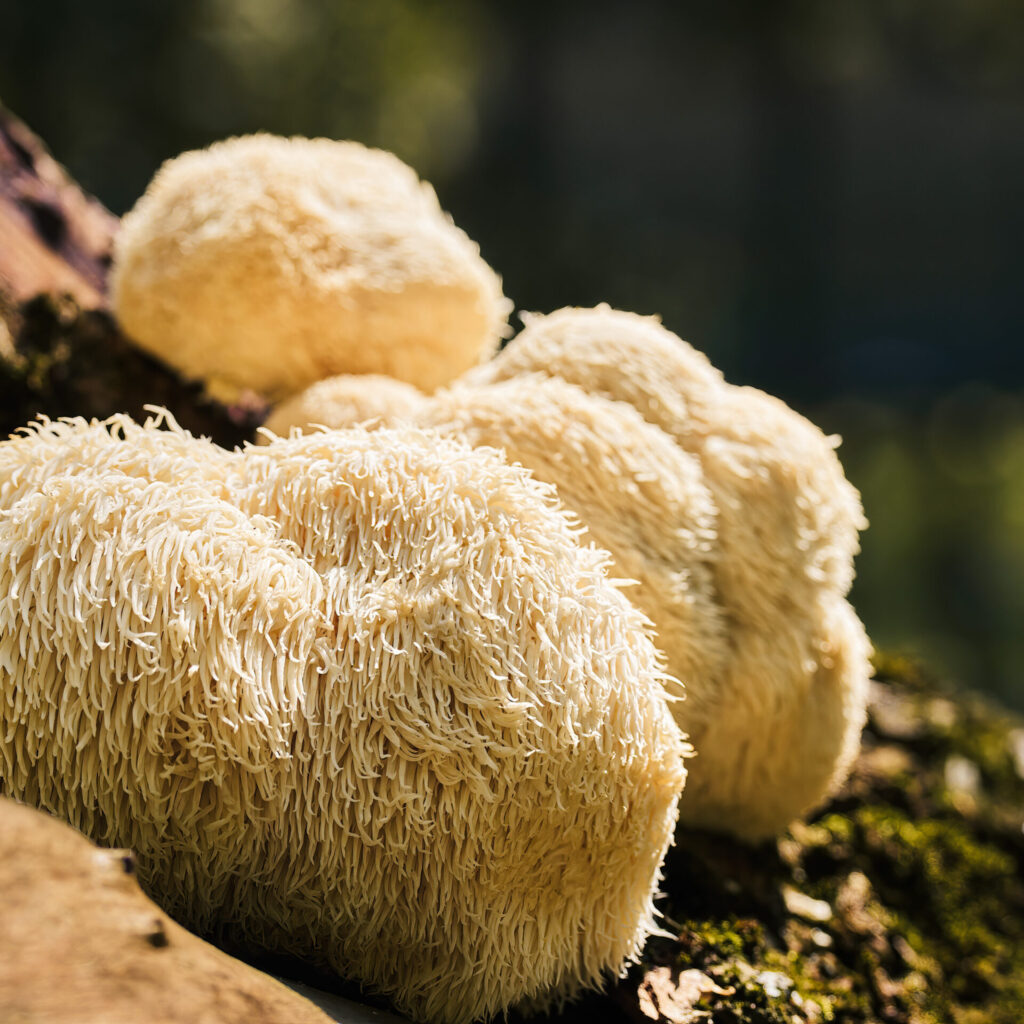
Lion’s Mane is a distinctive mushroom recognized for its cascading white appearance, often compared to the mane of a lion. Native to parts of Asia, Europe and North America, it grows naturally on hardwood trees, where it forms large white clusters resembling icicles or flowing hair.
For centuries, Lion’s Mane has been consumed as both a food and a functional mushroom throughout China, Japan and Korea. Its unique appearance, culinary value and long history of use have made it one of the most recognized mushrooms in East Asian herbal traditions.
In Japan, Lion’s Mane is known as Yamabushitake, meaning “Mountain Priest Mushroom,” and is assumed to be named after the Yamabushi monks. The Yamabushi were mountain ascetics who dedicated themselves to meditation, discipline and spiritual practice in remote natural environments. It is said that the mushroom was consumed to support focus and concentration during extended periods of meditation, contributing to Lion’s Mane’s enduring reputation within contemplative traditions.
A Japanese double-blind, placebo-controlled study published in 2009 helped bring wider scientific attention to Lion’s Mane and its unique compounds. In the study, adults aged 50–80 with mild cognitive impairment consumed Lion’s Mane for 16 weeks and demonstrated significantly higher cognitive test scores than the placebo group.
The study also helped draw attention to several naturally occurring compounds found in Lion’s Mane, particularly hericenones and erinacines. These compounds have since become a major focus of research due to their potential relationship with Nerve Growth Factor (NGF), a protein involved in the growth, maintenance and survival of nerve cells.
Its combination of traditional use, cultural significance and scientific research has helped establish Lion’s Mane as one of the most recognized mushrooms within both herbal traditions and functional foods.
Lion’s Mane is featured in Brainy Bite — a ritual bar inspired by focus, creativity and deep work.
DISCLAIMER
The information provided in The Herbal Library is intended for educational purposes only and should not be interpreted as medical advice. Our products are not intended to diagnose, treat, cure or prevent any disease.
REFERENCES
 EN
EN  NO
NO